


Breitling recaptures the spirit of the 1960s with two new 41 mm Navitimers featuring hand-wound manufacture movements, vintage-inspired dials and the return of the historic Twin Jet logo.
Breitling is expanding its permanent Navitimer collection with two additions, the Navitimer B09 Chronograph 41 and the Navitimer B02 Chronograph 41 Cosmonaute.
Both models feature a 41 mm stainless steel case, a hand-wound manufacture calibre and a power reserve of approximately 70 hours. Their appeal, however, goes beyond the specifications. Each represents a different chapter in Breitling’s history.
Navitimer B02 Cosmonaute: from the cockpit to space

Breitling Navitimer B02 Chronograph 41 Cosmonaute AB0230211B1X1 with black dial.
The Cosmonaute dates back to 1962, when astronaut Scott Carpenter asked Breitling for a Navitimer with a 24-hour display so he could tell day from night while orbiting Earth.
Carpenter wore the watch on the Mercury-Atlas 7 mission on 24 May 1962, making it the first Swiss wristwatch to travel into space.
The new B02 Chronograph 41 retains that distinctive 24-hour display and pairs it with a black dial, contrasting white chronograph counters and an integrated date display.
It is powered by the hand-wound Breitling Manufacture Calibre B02, developed specifically for the Cosmonaute. The movement features a column wheel, a vertical clutch, COSC chronometer certification and a power reserve of approximately 70 hours.
It comes on either a gradient brown calfskin strap or a seven-row stainless steel bracelet. It is one of the most distinctive interpretations of the Navitimer.
Navitimer B09 Chronograph 41: the character of the reverse panda dial
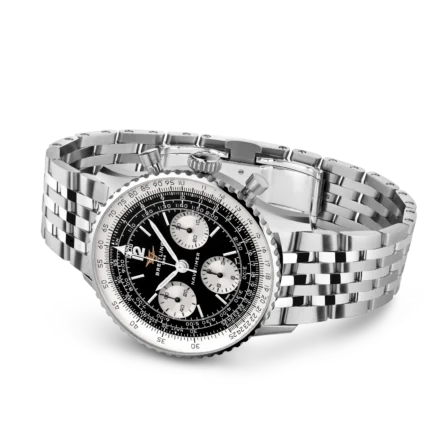
Breitling Navitimer B09 Chronograph 41 with black reverse panda dial.
The B09 brings a different character to the collection. Its reverse panda dial, available in black or blue with contrasting white counters, recalls the classic chronographs of the 1960s.
It also marks the arrival of the hand-wound B09 calibre in the permanent Navitimer collection, after being used primarily in special and commemorative editions.
The movement offers a power reserve of approximately 70 hours and features a column wheel and a vertical clutch. The chronograph has a central seconds hand, a 30-minute counter and a 12-hour counter. The dial has no date display.
Both dial versions are available with a leather strap or a seven-row stainless steel bracelet.
The return of the Twin Jet logo
One of the most interesting details the two watches share is the return of Breitling’s Twin Jet logo.
Introduced in 1957, the emblem first appeared on Navitimer dials in 1965. Its return on these models strengthens the link to Breitling’s historic designs and gives the watches a period look that enthusiasts will appreciate.
Two Navitimers, two distinct personalities
Although they share the same case dimensions and both use hand-wound movements, the B09 and B02 have distinct personalities.
The B09 is arguably the more classic choice, with a reverse panda dial that closely echoes traditional Navitimer design.
The Cosmonaute is the more specialised of the two, distinguished by its 24-hour display and its remarkable connection to the history of space exploration.
For collectors, perhaps the most significant development is the addition of both hand-wound calibres to the permanent Navitimer collection. This makes two historically significant configurations available without having to wait for another limited edition.
With these two watches, Breitling continues to build on its heritage while preserving the technical and aesthetic identity that has made the Navitimer one of the most recognisable collections in fine watchmaking.


 Contact
 Jewels
 Watches
 Search
 Compare
 Top
